Three books on the question every AI programme eventually has to answer.
Capability is what a machine can do.
Authority is what an organisation permits it to do.
The AI Governance Operating Series by Patrick Upmann — AI Governance Advisor, keynote speaker and author based in Munich. Three executive reference works for boards, AI offices, legal, risk, compliance and enterprise architecture: from principles to evidence, from usage to economics, from capability to authority.
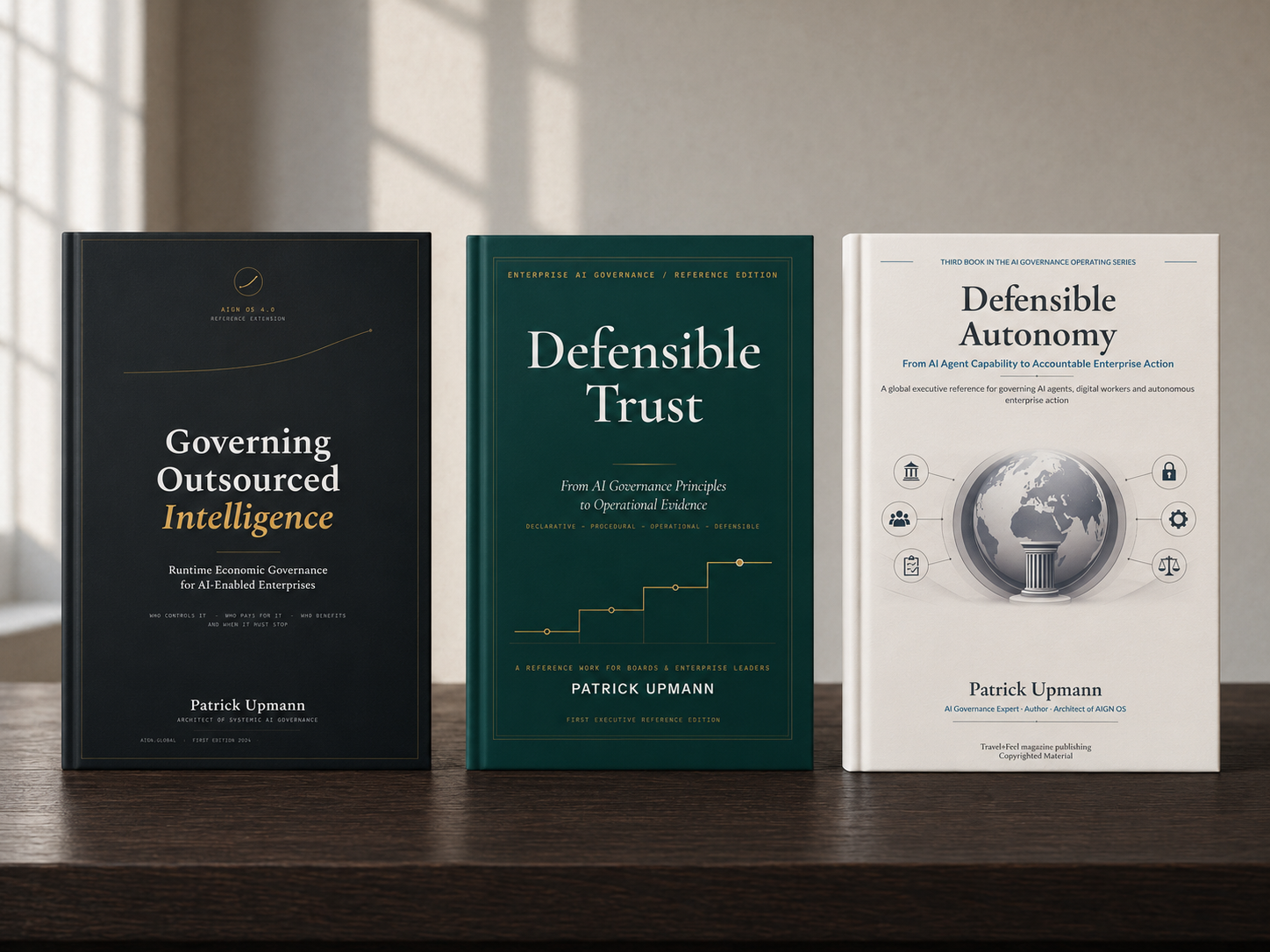
One argument, three books
Each book stands on its own, but they build on each other. Book One establishes how control becomes provable. Book Two establishes what intelligence costs when you rent it. Book Three establishes what an organisation may permit a machine to do in its name.
Defensible Trust
From AI Governance Principles to Operational Evidence
Many organisations now have AI policies, responsible AI principles, committees and risk statements. But when AI acts inside real workflows, a different question emerges: can the organisation prove control?
Which AI system was used, what data did it access, what was it allowed to do, which human role reviewed the result, what evidence was captured, what cost was created — and did the system remain within its approved boundary? Defensible Trust introduces defensible trust as a practical governance category and explains why the next era of AI governance will be defined by evidence, classification, permission, runtime control and board-level assurance.
It must be operationally evidenced.
- Moving from principle-based to proof-based governance
- Closing the AI evidence gap
- Governing AI agents as operational actors
- Classifying AI use cases before automation
- Defining permission envelopes for AI-enabled systems
- Building evidence wallets and trust dossiers
- Managing token cost and economic accountability
- Reporting AI control, risk and value to the board
Connects the EU AI Act, ISO/IEC 42001, NIST AI RMF, generative AI risk guidance and agentic AI security. Written as an executive reference work — not a legal manual, not a technical blueprint.
Governing Outsourced Intelligence
Runtime Economic Governance for AI-Enabled Enterprises
What happens when an enterprise redesigns itself around intelligence it does not own? AI is no longer merely a productivity tool. It is becoming a live operating-cost structure, an external dependency and, increasingly, a new layer of critical infrastructure.
The book examines the emerging economics of AI-enabled enterprises — token consumption, agentic workflows, supplier concentration, operational lock-in, declining internal capability — and introduces Runtime Economic Governance: a discipline designed to keep AI-enabled work economically controllable, value-producing, stoppable and strategically reversible while it is running.
It may begin with unmanaged dependency on externally priced intelligence.
- The Token Dependency Trap
- The Cognitive Infrastructure Curve
- Total Cost per Governed Outcome
- The Token Dependency Index
- Economic stop rules
- Runtime Economic Governance maturity model
- A practical 90-day implementation roadmap
Written for boards, executives, CFOs, CIOs, CROs, enterprise architects, procurement teams, auditors, regulators and public institutions. The governing question: which AI workflows create measurable value — and which merely create usage?
Defensible Autonomy
From AI Agent Capability to Accountable Enterprise Action
AI is moving from assistance to action. The governance question is no longer only what a model can generate, but what an organisation permits a machine to do.
As AI agents gain access to data, tools, workflows and enterprise systems, they can influence decisions, communicate externally and execute actions on behalf of an organisation. This creates a new governance challenge: how to define machine authority without weakening human accountability.
Authority is what an organisation permits it to do.
- The Agent Mandate
- The Authority Envelope
- The Human Accountability Anchor
- Runtime Policy Enforcement
- The Action Evidence Chain
Applied to agent identity, data and memory, tool use, transactions, external communication, multi-agent delegation, third-party systems, incident response and organisational oversight. With documented cases and research findings, sector-specific examples, control blueprints, evidence requirements, leading indicators, board and executive questions, and a 90-day implementation plan. Autonomy should be bounded, observable, reversible and supported by evidence — while accountability remains with people and institutions.
Books by Patrick Upmann on AI governance
Which AI governance books has Patrick Upmann written?
Patrick Upmann is the author of The AI Governance Operating Series: Defensible Trust — From AI Governance Principles to Operational Evidence, Governing Outsourced Intelligence — Runtime Economic Governance for AI-Enabled Enterprises, and Defensible Autonomy — From AI Agent Capability to Accountable Enterprise Action. All three are published in English as paperbacks.
In which order should the books be read?
Each book stands on its own. To follow the full argument, start with Defensible Trust (proving control), continue with Governing Outsourced Intelligence (economics and dependency), and finish with Defensible Autonomy (authority and autonomous action).
Who are the books written for?
Board members, executives, AI governance leaders, legal and compliance teams, risk professionals, auditors, enterprise architects, security leaders, CFOs, CIOs, procurement teams, public-sector decision-makers and business owners.
Do the books cover the EU AI Act and ISO/IEC 42001?
Yes. The books connect current regulatory and assurance developments — including the EU AI Act, ISO/IEC 42001, NIST AI RMF, generative AI risk guidance and agentic AI security — with operational control and evidence models. They are written as executive reference works, not legal commentary.
Where can the books be bought?
All three titles are available as paperbacks on Amazon — Defensible Trust, Governing Outsourced Intelligence and Defensible Autonomy.
Disclosure: the Amazon links on this page are affiliate links. Buying through them costs you nothing extra.