Patrick Upmann

AI Governance. Built it. Written it. Defending it.

Kategorie: White Paper

The white paper “AI Governance – Foundations, Challenges, and Opportunities” outlines the necessity of effective governance frameworks to ensure that AI systems are developed and used ethically, transparently, and in compliance with laws. Core principles such as transparency, accountability, fairness, and data protection are emphasized. Key challenges include regulatory diversity, technological complexity, and establishing globally applicable ethical guidelines. However, robust AI governance can build trust, provide a competitive advantage, and foster innovation. The conclusion stresses that strong governance is essential for responsibly leveraging AI’s potential while mitigating its risks.

  • Navigating Compliance and AI Ethics

    A Strategic Guide to Implementing Effective AI Governance under the EU AI Act

    Unlocking the Future of Responsible AI 
    With the EUAIAct now in effect, companies face the challenge of integrating AI while navigating complex regulatory requirements and upholding high ethical standards. Our latest WhitePaper, „Navigating Compliance and Ethics: A Strategic Guide to Implementing Effective AI Governance under the EU AI Act,“ is here to guide you through every step.

    From aligning AI initiatives with corporate goals to ensuring data integrity and bias reduction, this whitepaper offers practical insights to help leaders make informed, responsible choices in the evolving AI landscape.

    👉 Ready to lead in compliant, ethical AI? Dive into our guide and start building a future-proof AI strategy today.

    Leverage External Expertise for Effective EU AI Act Implementation

    Implementing the EU AI Act’s requirements presents complex challenges for organizations. Engaging external consultants provides specialized expertise essential for successful execution. They assist in adapting and integrating AI systems, ensuring compliance, and offering employee training. Their support enables more efficient and cost-effective project realization, minimizes regulatory risks, and secures competitive advantages. Utilize this expertise to future-proof your organization.

    White Paper – Navigating Compliance and Ethics von Patrick Upmann

    Inhalte nur fĂĽr Abonnenten

    FĂĽge hier Inhalte hinzu, der nur fĂĽr deine Abonnenten sichtbar ist.

    Abonnieren und Zugang erhalten

    SchlieĂźe noch heute dein Abonnement ab und lese mehr von diesem Inhalt.

  • Why Artificial Intelligence Requires Change Management

    Why Artificial Intelligence Requires Change Management

    Unlocking AI’s Full Potential: Why Change Management is Key 

    As companies race to integrate AI into their operations, many overlook a critical component: CM. AI isn’t just about new technology—it’s a transformative shift that redefines workflows, decision-making, and company culture. Without a structured change management strategy, organizations risk facing resistance, skill gaps, and missed opportunities.

    In our latest white paper, we explore:

    • The necessity of change management in AI projects
    • Real-world use cases across industries
    • Strategies to minimize employee resistance and ensure successful AI integration

    Curious how CM can shape your AI journey? Dive into the details and discover how to lead a smooth transition that unlocks the full potential of AI. đź’ˇ

    White Paper – Why Artificial Intelligence Requires – Changes Management von Travel+Feel magazine publishing e.K Patrick Upmann
  • AI Competence 360°

    AI Competence 360°

    Introduction to the WhitePaper: AICompetence360° – Requirements, Knowledge, and Skills for Sustainable Success.

    In an era where artificial intelligence is becoming the core of modern business models, comprehensive preparation is the key to success. Our white paper, „AI Competence 360° – Requirements, Knowledge, and Skills for Sustainable Success,“highlights the essential requirements, knowledge, and skills that businesses need for a successful and sustainable start to their AI initiatives.
    Why is thorough preparation so crucial?

    The success of any AI project depends not only on its technical implementation but also on its seamless integration into businessstrategy and adherence to regulatory standards.

    This white paper explores shortly how organizations can balance business needs, technical requirements, and regulatory frameworks to remain competitive in the long term.

    This white paper is essential for leaders and decision-makers looking to integrate AI into their business strategies with a focus on sustainable success.

    AI Competence 360° von Travel+Feel magazine publishing e.K Patrick Upmann

    More White Paper

  • Launching Your AI Governance Strategy

    Launching Your AI Governance Strategy

    Introducing Our Latest White Paper on AI Governance

    As Artificial Intelligence continues to transform industries worldwide, responsible governance becomes more crucial than ever. Our latest white paper, „Launching Your AI Governance Strategy,“ explores the essential components needed to navigate the evolving regulatory landscape effectively and unlock the full potential of AI within your organization.

    In this white paper, we discuss why now is the time to take action, especially with the EU AI Act and other global regulations setting new expectations for transparency, fairness, and data protection. We outline how early compliance not only helps align with regulations but also establishes significant competitive advantages and builds trust with stakeholders.

    Explore actionable insights on compliance, ethics, data quality, and technical measures to ensure your AI initiatives are both innovative and responsible. Whether you’re just beginning your AI journey or refining your current approach, this white paper provides a strategic guide to make informed decisions and secure your AI projects for the future.

    Ready to elevate your AI governance? Click below to access the full white paper and start shaping a responsible AI future today.

    White Paper – Launching Your AI Governance Strategy von Travel+Feel magazine publishing e.K Patrick Upmann
  • Top 20 State of the Art Evaluation Methods

    Top 20 State of the Art Evaluation Methods

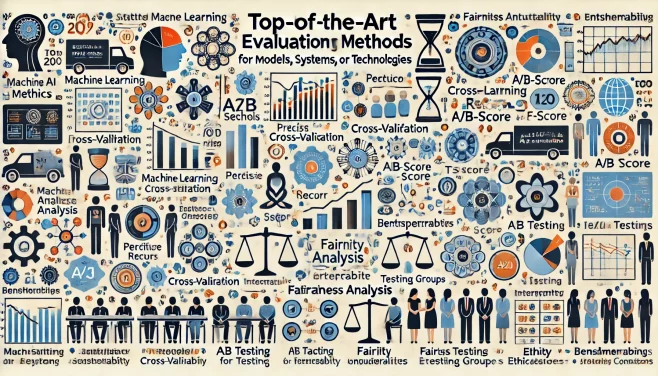
    The Top 20 state-of-the-art evaluation methods encompass advanced techniques to assess models, systems, or technologies.


    They include both qualitative and quantitative approaches, such as Machine Learning metrics like Precision, Recall, and F1-Score, Cross-Validation for statistical robustness, A/B testing to measure performance in real-world scenarios, and benchmarking against existing standards. More recent methods include interpretability tests to evaluate the transparency of AI models and fairness analysis to identify potential biases. These methods help in evaluating the efficiency, accuracy, robustness, and ethical considerations of modern systems comprehensively.

    Top 20 State of the Art Evaluation Methods AI Language Models in the Context of the EU AI Act von Travel+Feel magazine publishing e.K Patrick Upmann